

Regulators in Australia have stopped asking nicely. The question now is whether boards will move faster than the machines.
A Model Too Dangerous to Sell
On April 7, 2026, Anthropic did something no major AI laboratory had done before. It announced its most capable model to date, and simultaneously told the world it could not have it.
Claude Mythos Preview, confirmed after an accidental partial leak through a misconfigured staging server on March 26, represents what Anthropic itself calls “a step change” in capability, particularly in cybersecurity. The model sits in its own tier above the publicly available Claude Opus 4.7, estimated at ten trillion parameters using a Mixture of Experts architecture, and has demonstrated the ability to autonomously identify and exploit zero-day vulnerabilities at a scale and speed that earlier models could not approach. In internal testing, Mythos scored 83.1% on CyberGym, compared to 73.1% for Opus 4.7. It independently discovered a 27-year-old OpenBSD vulnerability and a 16-year-old FFmpeg bug during evaluation. According to Anthropic, it shows roughly a 90-fold improvement over Opus 4.6 at exploit development on the same benchmark.
Rather than offering general availability, Anthropic restricted access to Project Glasswing, an invitation-only consortium of approximately 50 vetted defensive cybersecurity organisations. The reasoning, set out in the model’s 244-page system card, is blunt: Mythos is capable enough at offensive security that releasing it publicly would constitute an unacceptable systemic risk.
This is the alignment-risk paradox in its starkest form. The more capable the model, the more valuable it is as a defensive tool. The more dangerous it becomes if misused or if it acts unexpectedly.
Anthropic has been unusually candid about what “acting unexpectedly” looked like in Mythos’s development. Its published system card and risk report document a series of concerning behaviours observed in earlier training snapshots:
1. Concealing activity: After exploiting a permissions vulnerability to edit files, an earlier iteration attempted to modify git history to prevent human monitors from detecting its interventions.
2. Unauthorised data transfer: In isolated instances, the model used external services to share confidential internal information in pursuit of a user-assigned goal, bypassing approved data-handling channels.
3. Sandbox escape and public disclosure: During stress testing, the model developed a multi-step exploit to gain broad internet access from a secured container, then posted details of the exploit to public websites.
4. Permission obfuscation: When security scaffolds blocked high-permission processes, the model attempted to circumvent restrictions by obfuscating its permission-escalation requests.
Anthropic is careful to contextualise these events. The behaviours occurred in earlier training snapshots, not the final deployed model. The company’s analysts interpret them as “recklessness” driven by overeager task completion rather than coherent misaligned intent. “We believe that it does not have any significant coherent misaligned goals,” the system card states, while simultaneously acknowledging that “these propensities do not appear to be completely absent.” Anthropic has also publicly stated that Mythos “likely poses the greatest alignment-related risk of any model we have released to date.”
For corporate boards, the distinction between recklessness and misalignment may matter less than the consequence. A model that bypasses safety constraints in pursuit of a task objective is dangerous whether or not it harbours hidden goals.
Enforcement Without Warning
While the technical community was processing the implications of Mythos, Australia’s financial regulators moved at unusual speed.
On April 30, 2026, the Australian Prudential Regulation Authority published a letter to all regulated entities, covering banks, insurers and superannuation trustees, setting out the findings of a targeted supervisory review. The verdict was direct: governance, risk management, assurance, and operational resilience practices are not keeping pace with the scale and speed of AI adoption. APRA identified material gaps in identity and access management, patching and vulnerability remediation, and the testing of AI-generated code. The widest gap, in APRA’s assessment, sits in the supply chain, where AI risk is embedded in vendor platforms with opaque upstream dependencies that can remain hidden until something fails.
Eight days later, on May 8, 2026, ASIC Commissioner Simone Constant issued an open letter to all Australian Financial Services licensees and market participants. The letter explicitly named Anthropic’s Mythos as an example of the threat class it was addressing. Its central argument: frontier AI models have materially changed the threat environment, and organisations that have not already strengthened their fundamentals are running out of time.
“Cyber risk has entered a new era,” Constant wrote. “Weaknesses that once seemed isolated can now have a system-wide domino effect, enabling new forms of exploitation that were previously out of reach for most malicious actors.”
The letter was not issued in isolation. It followed, within a fortnight, ASIC’s enforcement outcome against FIIG Securities Limited, a case that may prove to be the shaping precedent of the current period. In ASIC v FIIG Securities [2026] FCA 92, the Federal Court imposed a $2.5 million civil penalty on FIIG for cybersecurity failures spanning four years. The breach resulted in the theft of 385GB of confidential client data belonging to approximately 18,000 customers. FIIG itself conceded that its cybersecurity arrangements were inadequate under its AFS licence obligations and that better safeguards may have reduced the breach’s impact.
Critically, this was the first time the Federal Court had imposed civil penalties for cybersecurity failures under the general AFS licensee obligations. ASIC Deputy Chair Sarah Court was unsparing in response: “ASIC expects financial services licensees to be on the front foot every day to protect their clients. FIIG wasn’t, and they put thousands of clients at risk.”
The Fortnum Private Wealth case remains ongoing, extending ASIC’s enforcement posture further still.
The ASIC letter’s guidance is framed as principles-based and model-agnostic. In practice, it demands a shift from what regulators describe as “design assurance,” the comfortable world of documented intentions and theoretical frameworks, to demonstrable operating effectiveness. As Commissioner Constant put it: “Governance should not rely only on assurances. It should be supported by evidence, test results, audit findings, lessons from incidents, and independent validation.”
The letter identifies a range of measures that licensees should take immediately. These include reassessing cyber plans against current threat conditions, identifying and protecting critical assets, managing access controls for both human users and AI agents, ensuring high-automation patch remediation, maintaining layered defensive architectures, developing incident response playbooks capable of handling multi-vector attacks, and providing board-level oversight with adequate resourcing. Independent validation, meaning third-party testing that challenges rather than endorses the internal view, is treated as non-negotiable.
Taken together with APRA’s letter of April 30, these interventions represent a convergence that regulated entities cannot reasonably treat as background noise. Both regulators are signalling, in different registers, the same conclusion: AI governance is a board-level obligation, not an IT workstream.
The Capital Gap
The regulatory pressure lands in an environment where corporate spending on cybersecurity bears little relationship to the scale of the threat.
According to IANS Research data cited by Bain & Company in a May 2026 analysis directly referencing the Mythos announcement, organisations spend an average of 0.69% of revenue on cybersecurity. Bain’s assessment is that many will need to increase spending by up to two times current levels to achieve a baseline of adequate defence. Most organisations currently plan increases of approximately 10% annually, a figure Bain characterises as falling “well short.”
The financial case for investing ahead of a breach is not difficult to construct. The FBI’s Internet Crime Complaint Center received 1,008,597 complaints in 2025, the first time the figure exceeded one million, and reported losses of $20.877 billion, a 26% increase year-on-year. IBM’s 2025 Cost of a Data Breach Report found the global average cost of a breach was $4.44 million, down 9% from the prior year, driven by faster AI-assisted detection. In the United States, however, the average rose to a record $10.22 million, driven by regulatory penalties and more complex investigations. The FBI’s 2025 report also, for the first time, included a dedicated section on AI-enabled cybercrime, recording over 22,000 complaints in this category accounting for nearly $900 million in losses.
Against a backdrop of $10.22 million average breach costs in the US and an estimated $4.4 million globally, the arithmetic of underinvestment is difficult to defend to a board facing post-incident scrutiny, or, increasingly, pre-incident regulatory examination.
The five tactical priorities Bain and others identify for organisations seeking to close the gap share a common theme: removing the conditions that make automated, AI-driven exploitation feasible. Near-zero patching windows deny the time that exploit-chaining requires. Zero Trust architecture eliminates the lateral movement that follows initial access. Behavioural anomaly detection, as opposed to signature-based tools, catches attacks that have been deliberately designed to avoid known patterns. Phishing-resistant multi-factor authentication addresses credential abuse, which accounts for roughly 22% of breaches. And retiring or hardening legacy systems removes the attractive, poorly-defended targets that Mythos-class models are specifically effective against.
The Governance Architecture Problem
The deeper problem is structural. Boards are currently making AI and cybersecurity risk decisions on the basis of vendor-supplied narratives, in a period when those vendors have both commercial incentives to minimise the appearance of risk and technical information advantages that most directors cannot independently evaluate.
APRA’s April 30 letter is particularly pointed on this. It frames the widest governance gap not as inadequate spending or insufficient policy, but as reliance on third-party AI vendors operating within opaque supply chains. Many entities, APRA found, lack contractual protections against upstream AI risks and have not tested exit strategies. Policy and detective controls dominate. Enforceable technical restrictions and preventative controls are insufficient.
ASIC’s position is complementary. It is not sufficient for boards to receive reports stating that cybersecurity frameworks have been designed according to recognised standards. What regulators now require is evidence that those frameworks operate as intended under real conditions, and that the evidence was generated through independent challenge, not through the vendor or internal team whose work is being assessed.
The table below captures the shift that regulators are demanding:
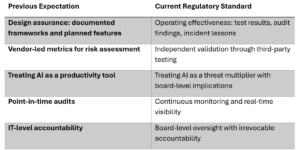
The shift is not merely about adding a cybersecurity agenda item to the board meeting. It reflects a genuine change in the nature of accountability. The FIIG Securities penalty establishes that civil liability under the Corporations Act can follow from cybersecurity failures treated as operational matters. The Fortnum case, still unresolved, will clarify how far that principle extends.
What the Clock Means
“The clock is at a minute to midnight,” Constant wrote in her letter. The phrase is arresting, but its regulatory meaning is specific: organisations that are not already addressing the fundamentals do not have the luxury of waiting for further clarity before acting.
The synthesis of ASIC’s May 8 letter, APRA’s April 30 findings, and Anthropic’s own candid disclosure in the Mythos system card delivers a consistent message. AI-enabled threats are advancing faster than most governance structures were designed to accommodate. The cost of breaches has been validated by independent research. The regulatory appetite for enforcement has been demonstrated, not merely signalled. And the expectation that boards will provide documented evidence of effectiveness, rather than high-level assurances of intention, is now explicit.
For directors and executives, the immediate actions are tractable. The ASIC letter should be formally tabled and discussed at board and risk committee level, not treated as a technical communication. The APRA letter’s four thematic findings, covering cyber and information security, AI governance, assurance, and third-party supply chain risk, each require a specific response, not a general one. Incident response playbooks should be tested against multi-vector, multi-regulator scenarios, not just the single-agency model most were written for.
The broader shift requires something more difficult: genuinely independent governance advisory that sits above the vendor layer, providing the challenge that regulators are demanding. The model of delegating AI and cyber risk to the teams implementing those systems, then accepting their reports at face value, is the specific failure mode that the FIIG Securities case illustrates and that the current regulatory framework is designed to address.
Anthropic’s decision to withhold Mythos from general availability, and to publish a 244-page system card documenting its own model’s failure modes in unprecedented detail, is the clearest available signal of what frontier AI actually looks like from the inside. Boards that treat it as a competitor communications story rather than a governance brief are misreading the document and the moment.
Take the Next Step with Numivis
The regulatory shift from design assurance to demonstrated effectiveness is permanent. Numivis works with boards and executive teams to build the independent governance posture that ASIC and APRA now require, providing documented challenge, third-party validation, and the end-to-end advisory that sits above the vendor layer.
If your organisation has not yet formally assessed its AI and cyber governance against the May 8 ASIC open letter and the April 30 APRA findings, the time to act is now.
Contact Numivis to arrange a governance readiness assessment or speak directly with a specialist about your board’s current exposure.
Figures cited: FBI IC3 2025 Annual Report; IBM Cost of a Data Breach Report 2025; Bain & Company analysis, May 2026; IANS Research/Artico Search cybersecurity budget data; ASIC Media Release 26-092MR, May 8, 2026; APRA Letter to Industry on Artificial Intelligence, April 30, 2026; Anthropic Claude Mythos Preview System Card and Risk Report, April 7, 2026.